1/26/2008

Nazca, Peru

After my sandboarding adventure, I took a quick bus to Nazca to check out the Nazca lines. Machu Picchu and the Nazca lines were the two things I wanted to make sure I saw while in Peru an with my arrival in Nazca I was about to check one of those off of my list.

I know it looks like nothing is in this picture, but there is a monkey in the lower left corner (I swear).

Little is known about these lines in the middle of the desert, other than they were constructed (or drawn) by the Nazca people sometime between 200 BC and 700 AD. Not very specific. Also, the lines cannot be seen from ground level, you have to be in the air before you realize what they are so their purpose is also a bit of a mystery. Were they meant to be seen by a deity from above? Were they part of an astronomical calendar? Were they just creative buggers with too much free time? Despite not knowing much about them, they were still interesting to see.

Hummingbird

I got up early in the morning to take a half hour flight over the desert outside of Nazca to see the lines. One of the things that surprised me was how hard to was to see some of the images. The lines really blended in with the surrounding sand, but they were still amazing to see nonetheless. The pictures aren´t great, you can definitely find better ones online, but they give you a sense of what was seen from the air.

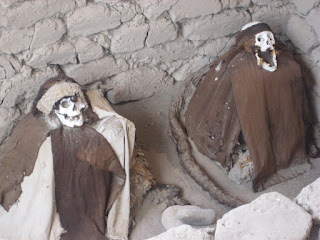
After my flight, I was whisked away in a van to the Chauchilla Cemetary, a Nazca burial ground a little over 1000 years old. Because of the incredibly dry climate in the area (less than 1 mm of rain per year), bodies were preserved very well and this area is home to many mummies. Before it was discovered by archeologists, the many tombs were raided by local people and the bodies were left strewn about the desert, but archaeologists have moved the mummies back to restorations of tombs underground (although still uncovered so that tourists can gawk). Despite the restoration, there are still lots bone fragments that stick out of the sand in the area.

More pictures of the Nazca lines and Chuachilla Cemetary are at my Picassa site in the Peru folder: http://picasaweb.google.com/jmellgren

1/24/2008

Sandboarding in Huacachina


After checking out Pisco and the Islas Ballestas, I took a two hour bus ride south to Ica. Ica is known for its wine and pisco producers, but my purpose was to visit the desert oasis of Huacachina.


Huacachina is a really relaxed village surrounding a lagoon, literally a desert oasis. Besides getting some time in at the pool, the best part about my time in Huacachina was taking a sand buggy tour through the dunes including several runs sandboarding.


First of all, keep in mind that this is Peru and safety is a bit of an after thought, but that also made the ride very enjoyable. Our crazy driver would go at top speed going up and down monstrous sand dunes. I thought we had big dunes in Michigan, but the dunes in Huacachina made Michigan´s seem like babies. Anyways, it is a bit hard to describe what the ride was like, but we basically just drove around the dunes at excessive speeds. We would go up a dune as fast as possible and then without slowing down to see what would be on the downslope we´d jump over the top and head back down. A blast.


The second part of the tour involved trying out sandboarding. Basically the same thing as snowboarding but you do it on sand. All of us in the group tried to do it standing up, but none of us could really get the hang of it so we switched to going down on our stomachs. Essentially just sledding headfirst down a giant sand dune. Again hard to describe, but a blast. Too give you some perspective as to how massive the dunes were that we went down, you can see some tiny people in the bottom left of the picture below who are at the bottom of the dune that we had just gone down on our boards.


Lastly, the dune tour ended with a sunset over the desert...amazing.

1/23/2008

Guano and the Ballestas Islands


After Lima I headed south to a beach side town called Pisco. I actually stayed just outside of Pisco in an ocean front hotel in a town called San Andres. It was great to be 20 meters from the ocean and to be able to fall asleep to waves crashing.


Pisco was actually nearly destroyed last summer when it was struck by an 8.0 magnitude earthquake in August. The effects of that can still be seen. Lots of rubble piles in the streets, people living in tents, buildings missing walls and roofs. Really crazy. Even the main church on the main square was destroyed. There are lots of volunteers and international aid groups in Pisco and they are making slow but steady progress rebuilding the city. Very sobering to walk around and see how much damage is left, even after almost 6 months.


My main purpose in visiting the Pisco area was to check out the Islas Ballestas, also called the ¨Poor Man´s Galapagos.¨ Basically they are several small islands in the Pacific Ocean that has an abundance of birds, penguins and sea lions. To get to the islands you have to take about a 45 minute boat ride, and mine was full of Russian tourists who didn´t speak a word of English. Despite this, they wanted to have conversations with me, and I don´t think we ever understood what we were talking about, but it was fun nonetheless. Along the way to the islands we stopped to check out a giant geoglyph on the side of a sand dune. It is called the Candelabra Geoglyph, but nobody really knows what it is, how old it is or who made it. At 150 meters tall and 50 meters wide, it is quite the site, very cool to see.


After looking at the candelabra for a while we headed to the islands, stopping to watch some dolphins play before making it to the islands themselves. They look like giant white boulders jutting out of the ocean by about 5-30 meters, but once we got closer I realized that the rocks were actually a reddish brown, but stained white due to all the bird poop. I´ve never seen so much bird poop in my life. The guide told us that the black cormorants on the island produce the world´s best guano and that they harvest it every 10 years. Lots of birds, penguins and sea lions and lots of noise, but a very interesting sight. I wonder why all these animals chose this random group of small islands to call home?


On the boat ride back to the mainland, we got engulfed by fog and we could barely see the water in front of us. The guide and boat driver both looked concerned and were both pointing in random directions, I think trying to decide where to go. Eventually we found the mainland but were about 1 km away from the pier. Oops. Anyways, really creepy getting to the pier and slowly seeing the fishing boats appear, almost like something out of a horror movie.


More pictures from the Ballestas Islands and Pisco can be found in the Peru folder at: http://picasaweb.google.com/jmellgren

1/22/2008

Lima, Peru


After a couple relaxing weeks in Roscommon, MI (and Chicago, IL and Sacramento, CA) I am back in South America. It feels great to be back on the road, although I do miss drinking out of the tap and flushing my toilet paper.

I arrived in Lima, Peru just before midnight on Monday but didn´t end up leaving the airport until nearly 2 am. This was because I had to wait for every single bag to be unloaded before hearing an announcement that 21 bags had been left in Houston, including mine. They would not be able to make it to Lima until the flight the next day that was also supposed to arrive just before midnight and then they would drop it off at my hotel the next morning. Lucky John (and his lucky dorm mates) got to wear the same clothes for 3 days straight before my bag caught up to me. I frequently wear the same clothes over again, but the forced wearing of the same clothes was a bit of a pain, especially since I was wearing some heavy pants (it was below freezing and a blizzard when I took off from Traverse City, MI) and it was in the 90s in Lima.

Continuing the having a bad day theme, besides having my luggage left in Houston, within the course of 36 hours I also locked my keys inside my security locker (with my camera, passport and money inside as well) and was denied entrance to the Bolivian embassy. At first it was because I didn´t have my passport. I did have my Michigan driver´s license though, and was hoping that would work. After about 5 minutes, the guard finally got permission for me to enter without my passport, but was then told that because I was wearing shorts, I would be unable to come in. I would have to go change into long pants and return. And all I wanted to know was what I needed to do to get a visa for Bolivia. Que será, será.

Besides that little hiccup, my time in Lima was amazing. I was only going to spend two nights or so in Lima but ended up staying an entire week. Before coming I only heard negative things from travelers about Lima. I was told it was dirty, unsafe and that there wasn´t much to do. While one can find dirty and unsafe areas in just about any major city, I found Lima to be great. Although I stayed in Miraflores, the ritzy, super modern, fancy area, I also was able to explore several other less prosperous districts and found them to be quite enjoyable. One bad thing about Lima is that it is hot and there seems to be a constant foggy haze along the coast. Oh well, compared to winter in Michigan, I´ll take it.


On my first night in Lima, I met up with Marcos, a friend of my first grade teacher Sra. Johanson. Marcos came to my hostel and picked me up and gave me a brief tour of Lima in his truck before treating me to dinner. After dinner, Marcos, who is in the Peruvian Air Force, brought me to the Air Force Officer´s Club to treat me to my first pisco sour. Pisco is a type of liquor made from grapes and is produced in Peru. Anyways, it was rather tasty. Gracias Marcos.


The next day Marcos sent his friend Tony to take me into the center of Lima to check out some of the historical sites. Among the sites visited was the Plaza de Armas (the main square), the cathedral on the Plaza de Armas and the Palacio de Gobierno (the Presidential Palace). I also took a tour of the San Francisco Church and Monastery. This church and monastery was built in the late 1600´s and has lots of original art and woodwork however the best part of the tour was exploring the catacombs. Below the monastery are several tunnels that they believe house the remains of around 70,000 bodies. They have excavated several of the bodies and have the bones on display. What was interesting about it was that it wasn´t whole bodies, but each type of bone was grouped together. All the femurs in one pile, all the tibias in another and the skulls in yet another. Kinda creepy but very interesting.

After touring the monastery, I visited the Museum of the Spanish Inquisition and Congress. An interesting combination to say the least. Anyways, this was a pretty boring museum, but I rather enjoyed the torture room where they had lifesize wax dummies being subjected to different types of torture. I loved the expression on the face of the guy getting choked by a rope (notice how much slack is in the rope).

I also found the masked man subjecting a woman to water boarding rather amusing. I wanted to believe that it was Dick Cheney beneath the black mask. Also funny that the torture the US uses seems to be exactly what the Spaniards used 500 years ago.

A great day being led around by Tony. I am very grateful that Sra. Johanson put me in touch with Marcos so that I had the opportunity to spend some quality time with people from Lima.

Another day I visited the pre-Inca site of Pachacamac, a few kilometers south of Lima. From a distance the site looks like several sand dunes, but once you get close you can see that they are pyramids and buildings that are mixed in with the sand. There were also great views of the ocean from the main Temple of the Sun, the tallest pyramid at the site. Although not the most impressive ruins I have seen, they were still interesting nonetheless and glad I made the effort to get out of Lima for the day to see them.


Besides the typical touristy stuff in Lima, I spent a lot of time just wandering around various parts of the city with people from the hostel looking for interesting places to hang out (and usually eat). This isn´t the first time that a city has sucked me in and kept me for longer than anticipated and probably won´t be the last.

I have decided to save northern Peru for another trip and I will begin making my way south very soon.

As always, there are more pictures of Lima in the Peru album at: http://picasaweb.google.com/jmellgren

1/20/2008

I´m Back....

For those of you who don´t know, I returned to the US for Christmas and New Years, basically just taking a break to see family and friends and to relax (travel is hard work!). Spent most of the time in Roscommon, MI but also spent time in Toledo, OH and Chicago, IL visiting friends for New Years. I also flew to Sacramento, CA to visit a law school (and friends who live there).


Me and my New Years Eve hosts in Chicago.

Anyways, I am back in Peru now and just spent an amazing week in Lima. I am now traveling south and will be posting details on what I´ve been up to in the near future. Cheers.

12/16/2007

A theft and I'm stuck in Iquitos

Well, the first unfortunate event (I suppose I should say involuntary) has occurred. My IPOD was stolen. It was a few years old and I was planning on replacing it upon my return to the US, but it still really ticks me off. It isn't even the financial loss. Those that know me know how important music is to me and the loss of the ability to listen to music is a very serious matter. Made even more serious by the fact that when it was stolen, I was on my way to a boat which I was to be on for 4 days as I traveled to Yurimaguas, Peru. The delay caused by my dealing with the stolen IPOD caused me to miss the boat to Yurimaguas and I am now unsure what I am going to do. The next boat isn't for a few days and I am ready to leave Iquitos. What a bummer. Anyways, one of the joys of traveling without an itinerary is that little events like this really don't throw off any grand plan. I can work around this, I just don't yet know how.


One thing I haven't mentioned yet is all the mototaxis in Iquitos. They are basically rickshaws attached to a motorcycle. They are very noisy and seem to be rather dangerous, but are the only way to get around town. It is also amusing to see them when it rains. I took the photo below as I was riding in one during a downpour. The driver left a couple inches just below the roof and just above the top of his tarp to see. Luckily he didn't hit anything.

12/15/2007

Jungle Tour


After being unsure of whether I would actually do a jungle tour or not, I finally decided to take the plunge and paid for a 4 night 5 day jungle tour. There would be two of us plus a guide. Raul, a Chilean, was to be my travel companion for the next several days as we traveled 250 km into the jungle. Our base camp was called Delfín Camp and consisted of a thatch roofed structure that included a common eating room, several screened in rooms and hammocks.


We stayed at the camp for two nights and camped in the jungle for two nights. I am not quite sure how to describe my experience. We would spend our mornings either going out in the canoe looking for wildlife or hiking through the jungle looking for wildlife. We would return to camp for the hot part of the afternoon and then head out again at night either in a canoe or on foot. As far as wildlife is concerned, we saw many monkeys, many birds, many freshwater dolphins, iguanas, a cayman, a turtle and an electric eel. The most abundant creature we saw was also the most unwelcome. Millions of mosquitoes managed to find us over the course of the five days. These also weren't like the mosquitoes I am used to back home. These were mosquitoes on steroids. Despite wearing plenty of insect repellent and two shirts (one long sleeve, one short sleeve) I still had bites all over. And when I say all over, I literally mean all over. Even when I was able to forget about the bites, there was still a constant buzzing in the ears as the flew around my head. It was the buzzing that nearly drove me over the edge to insanity. I had to keep reminding myself that I made the choice to pay money to experience the mosquitoes. Ooof.


Halcón, our guide, was very good at locating things in the trees and was also very good at making bird/animals calls. He always amazed me in that he knew the names of every animal, bird, insect, plant and tree that we would see and also knew the medicinal uses of the things we would find.


Our first day was spent mostly in canoe. We paddled to a small village called Libertad, arriving just before sunset, and wandered around for a bit. The village kids were all playing soccer and volleyball and it was fun to just sit and people watch for a while. As darkness fell, Raul and I entered a makeshift store (I think it was really just someones house) to get a cold drink. Since this village didn't have electricity, the cold part became problematic. The kind store owner offered to turn on his personal generator for a few minutes so that the fridge would cool down so our drink would be cold. After about a minute we were served our still warm drink. As you can imagine turning on a refrigerator for a minute isn't going to cool down anything, but I still really appreciated the effort though. After it was completely dark, we went out to look for caymans (a type of alligator). We were told to keep our headlamps off while our guide scanned the water for the reflection of eyes. After not finding anything for a very long time, Halcón suddenly drove his hand into the water and pulled out a cayman. It was about a year old and didn't really do much. I guess it was playing dead hoping we would leave it alone, which we eventually did.


After finally finding our cayman, we started paddling back to the camp. The paddling started to get very difficult as we were going through a very shallow area with lots of vegetation. Eventually Halcón just jumped out of the front of the canoe and started walking. Not a good sign. The river had evidently dropped several feet since he had come through last and we would not be able to paddle any further. We started dragging the canoe (keep in mind this is a 12-foot dugout canoe made of a single piece of wood and very very heavy) through mud that was up to the knees. I am not sure how far we dragged the canoe or how long it took us, but it seemed like hours (I think it was really less than 30 minutes) but tempers started to flare and some not nice language was used in the heat of the moment. Once again, I paid money to be able to do this. I should be happy. We made it back to camp around 10pm, ate dinner and immediately went to sleep. Long day.


I won't bore you with the details of every minute of the jungle tour (we saw a tree and then another tree and then a pretty bird...), it was something that is best experienced and not explained. The canoe trips were relaxing, the jungle hikes involved lots of mosquitoes and the camping in the jungle was an experience. While camping we slept in hammocks inside mosquito nets with a tarp on top to protect against the rain. One night as we were trying to fall asleep something that sounded like rocks started to hit the ground around us and the tarps with very loud thuds. Turned out to be a monkey eating a pine cone like fruit and as he was discarding the remains they would fall and make a loud noise as they hit the tarp and the ground. While I was glad the monkey found some food, I started to get very irritated at the constant barrage of fruit that kept me awake. As if there wasn't enough other noise and irritants to keep me awake in the jungle.

All in all my 5 days in the jungle were very good. I am very glad that I went on the trip and that I had the opportunity to delve deep into the jungle. While there were certain aspects of the trip that i wish had gone differently, I am still rather pleased.


More photos from my trip into the jungle at: http://picasaweb.google.com/jmellgren

12/10/2007

Amazon Golf Club


The owner of the hostel I stayed at in Iquitos was also an investor in the only golf course in the Peruvian Amazon jungle. In fact, I was told that it is one of only 16 golf courses in Peru and that it is the only course between Lima, Peru and Manaus, Brazil. Because of a legal dispute and a lack of appropriate permits from the provincial government, they are not allowed to charge money to play golf at the course. Bad news for the investors, good news for me. We were invited to head to the 9-hole course and play a round for free. We were even allowed to borrow some golf clubs and golf balls. The caretaker of the course, Maria came along as our caddy and her 3 children served as ball spotters for us. Three of us were golfing, Craig from England, Randy from Minnesota and myself.


We were warned before playing that one of the storage buildings is infested with snakes and to not search for any balls that go near it. We were also warned of a 3 meter cayman that likes to lounge in the water hazards on the course. I love golf in the jungle.


Because the course isn't officially open, the grass is a bit overgrown. Even perfect shots down the middle of the fairway are difficult to find (not that I was hitting many fairways). Although I didn't play my best it was still a great day. Maria's children would race each other to our balls after we hit them and try to be the first to find them. Like I said, it was a blast.

Supposedly the course will be opening up officially in January or February of 2008. There is even a clubhouse under construction that will have a proshop, bar and restaurant. Should be very interesting to see how golf is received in the jungle.

12/09/2007

Iquitos, Peru


After a couple days relaxing in Leticia, Colombia I decided to head into Peru via a long 12 hour boat ride up the Amazon River to Iquitos. Most maps say that the Amazon River starts someplace in Peru east of Iquitos where the Marañón River and the Ucayali River meet. Water from several rivers in Ecuador and further into Peru (as far as Cuzco) eventually dump their water into the Atlantic so who can really say where the Amazon River starts. Anyways, before my boat ride I had the pleasure of visiting 3 countries in less than 15 minutes. I woke up in Leticia, Colombia, took a taxi to Tabatinga, Brazil and then took a boat across the Amazon to Santa Rosa, Peru. Fun fun.


Anyways, Iquitos is a very interesting city. It is the largest city in the world that is not accessible by road, you can only get there by boat or by air. It grew to become so large due to a rubber boom in the late 1800's. In fact, on the Plaza de Armas in Iquitos there is a building (pictured above) that was built by Eiffel (the same guy who built the Eiffel Tower) in France. It was deconstructed in France and brought piece by piece to Iquitos where it was rebuilt. Why not?

Shortly after people discovered that they could make money off the rubber trees near Iquitos they also realized that they could make even more money if they just planted the rubber trees closer to the coast in Brazil so that they didn't have the transportation cost of getting the product from Iquitos to the Atlantic. Iquitos never quite recovered the prosperity that it saw back then, but it has become one of the main hubs for jungle exploration in Peru. Everyone you meet on the street wants to be your best friend and take you on a jungle trip.

I was unsure as to whether I would actually take a jungle trip or not. I really wanted to take advantage of the opportunity to go deep into the jungle, but I also didn't want to get ripped off and I didn't want to go with a shady tour guide. Luckily I met a guy from Duluth, Minnesota who had just returned from a jungle trip and he filled me in on his experience. In the end I decided to go with the same guide he used, however I will write a separate post on my trip into the jungle.


One of my only touristy activities in Iquitos was a visit to the Pilpintuwasi Butterfly Farm. Although it was very interesting to see the Butterfly Farm (and animal orphanage) I actually enjoyed the walk through the village leading up to the farm much more. It was a very laid back relaxing village called Padre Cocha where when people passed you they actually smiled and said "Buenos Dias" and most importantly didn't try to sell me anything. At the Butterfly Farm itself I was taken on a tour of the enclosure which had several different species of butterflies flying around. We were then taken a separate enclosure where they had eggs, pupae, larvae and caterpillars. I forget all the stages of the life of a butterfly and what order they are in, but it was still interesting to see. Lastly we were taken to see the various animals that they have at the farm. These included a tapir, a jaguar and an anteater. They also claim to have a cayman and a manatee however neither were visible. There were also several monkeys that were running around and jumping on us throughout the tour. They seemed friendly enough until one of them started to take stuff out of the pockets of a Spanish woman. Luckily I wasn't robbed by the monkeys. All in all it was a good visit, however for those of you from Michigan, the annual butterfly exhibit the Meijer Gardens in Grand Rapids is much more impressive. I guess the butterflies I saw here were actually in their natural habitat though.

On the walk back to the boat through the village I stopped and played soccer with some little kids. They were so much better than me and spent a fair amount of time laughing about my lack of soccer skills, however it was still a blast. It was nice to associate with some kids who weren't trying to sell me gum or convince me to buy them a hamburger.


On the boat ride back to Iquitos we found ourselves in a downpour. During the rainstorm the boat driver (I won't refer to him as a captain) kept running into objects in the river, culminating with hitting the only other boat within 100 yards of us. At this point everyone on board put on a life jacket (they kindly didn't leave one for me or the 80 year old sitting next to me though) however we eventually made it safely to Iquitos.


More photos from Iquitos in the Peru album at: http://picasaweb.google.com/jmellgren